
October 26, 2026
KAI Love vs Money
Story, Meaning & Sculpture
About KAI at Le Touquet 2027
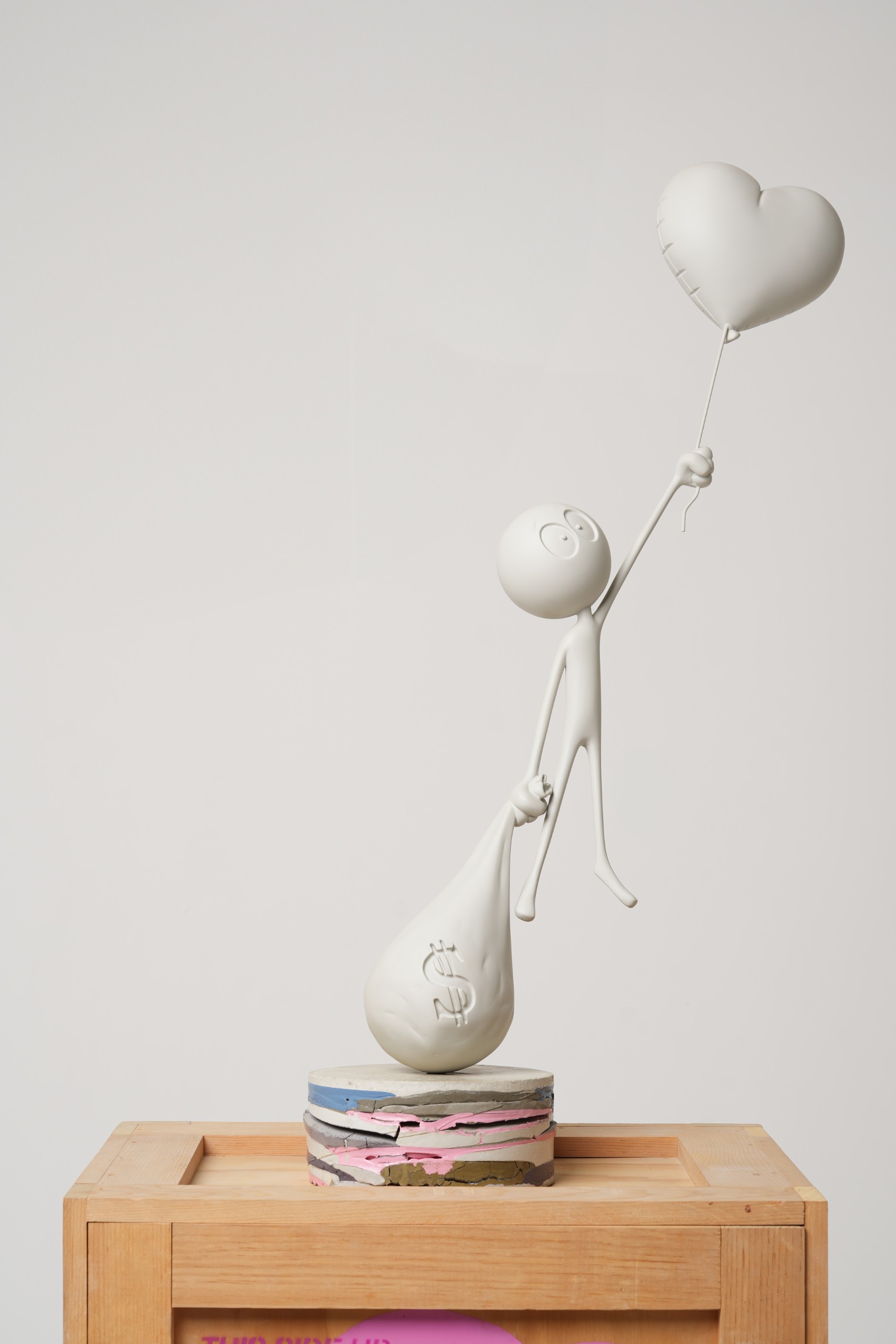
Few images capture the tension between emotional fulfillment and material ambition as directly as KAI’s Love vs Money. From street art plaques and unique concrete works to a sold-out print and monumental public sculpture, the composition became a defining image in the artist’s career. Discover its meaning, its evolution, and the historical 2019 three-foot sculpture presented by Markowicz Fine Art on the secondary market.
What Does KAI’s Love vs Money Mean?
A figure reaches upward, holding a heart-shaped balloon. A money bag pulls in the opposite direction. Between these competing forces, the character seems caught in a moment of possibility: almost flying, but not entirely free.
At the center of Love vs Money is IF, short for Imaginary Friend, the recurring character in KAI’s artistic universe. Its simplified appearance leaves room for viewers to recognize something of themselves. As described in the artist’s biography, IF carries emotions and experiences that can be understood across cultures and generations.
The heart-shaped balloon can be read as a symbol of affection, hope, or the pursuit of a meaningful life. The money bag suggests material attachment, but also security, responsibility, and the fear of letting go.
The image is therefore more interesting than a simple opposition between good and bad. It invites us to consider the competing priorities that shape our lives. What lifts us? What holds us back? And how do we decide what matters most?
The figure offers no final answer. Its unresolved position is precisely what makes the composition compelling.
From Street Art Plaques to an International Visual Language
Love vs Money developed within KAI’s street-based practice, where an artwork could be encountered unexpectedly rather than sought out inside a gallery.
The composition appeared through street art plaques, reliefs, murals, and sculptural interventions. The artist’s public-art archive documents versions in places including Paris, Aspen, Los Angeles, and New York, showing how the same central image could move between different cities and physical forms.
These settings are part of the work’s meaning. An image about love, ambition, and money takes on a particular immediacy when encountered during a commute, on a shopping street, or on the way to work.
A small plaque does not need to dominate its surroundings. It can interrupt an ordinary journey with a question that remains in the viewer’s mind long after the encounter.
This accessibility helped establish the character of Love vs Money. Its public life was not simply a preliminary stage before entering galleries. It shaped the way the image communicates.
Concrete: Preserving a Connection to the Street
The theme also developed through unique fine art works on concrete, retaining a material connection to its urban origins.
Concrete and cement occupy an important place in KAI’s practice. His biography connects these materials with sidewalks, architecture, labor, and public infrastructure, explaining how an everyday building material can become the setting for an emotionally charged image.
Within Love vs Money, that relationship creates a striking contrast. The balloon suggests lightness, while the support introduces physical weight. An image of emotional release is held within a material associated with solidity.
The concrete works can therefore be understood as more than another version of a recognizable composition. Their material contributes to the experience of the image, preserving something of the street while inviting closer, more sustained attention.
The 2017 Love vs Money Print
An important chapter in the composition’s history came with the release of the Love vs Money serigraph in September 2017.
Markowicz Fine Art’s original launch announcement, published on September 12, introduced KAI’s first serigraph featuring IF and announced its online release for September 14. The work was produced as an eight-layer screenprint on archival paper, measuring 28 × 20 inches, in an edition of 300 hand-signed examples.
The edition sold out within minutes of its release, a response also documented in Bel-Air Fine Art’s account of the artist’s career.
The significance of the print was not limited to the speed of its sale. The release was conceived as a more accessible way to own KAI’s work, allowing an image associated with public encounters to enter homes and personal collections.
For Markowicz Fine Art, the launch is also part of our documented history with the artist. It records a moment when Love vs Money connected KAI’s street-based imagery with a growing audience of collectors.
Translating the Image into Sculpture
The move into freestanding sculpture gave Love vs Money a new physical presence.
In a print or wall-based work, the opposing forces are contained within an image. In sculpture, they occupy actual space. The viewer can move around the figure, follow the upward line of the balloon, and observe the relationship between apparent lift and weight.
The composition asks us to imagine gravity, resistance, and balance acting on the body.
This sculptural development was already visible in 2017, when a monumental Love vs Money installation appeared at the entrance to CONTEXT Art Miami, as documented in the artist’s public-art archive. The three-foot sculpture dated 2019 belongs to this developing sculptural history, rather than representing the first appearance of the subject in three dimensions.
For Markowicz Fine Art, this transition helps explain why the composition marks a defining chapter in KAI’s career. An image that communicated through a small street intervention also proved capable of sustaining a freestanding sculpture and a monumental public presence.
Love vs Money at Citygarden in St. Louis
The monumental version at Citygarden in St. Louis, Missouri, is an important part of that public history. The work is documented in Citygarden’s official collection, associated with the Gateway Foundation.
Its presence in a public sculpture garden gives the composition another relationship with its audience. Rather than requiring a visit to a commercial gallery, the work becomes part of a shared environment.
There is a meaningful continuity between this setting and KAI’s earlier street interventions. Both bring the image into everyday experience. The monumental scale, however, changes the encounter. A subject once discovered on a wall becomes a visible presence within the surrounding landscape.
The composition retains its emotional clarity even as its scale changes. Viewers do not need to know the history of the print or the concrete works to recognize the tension expressed by the figure.
The 2019 Three-Foot Sculpture
The 2019 three-foot Love vs Money sculpture brings the composition to a scale suited to a private collection.
The gallery catalogue records fiberglass, a concrete base, and an internal steel structure, with a height of approximately 92 centimeters. It identifies a numbered edition of eight, with individual edition numbers and artist’s proofs distinguished in the listing.
At this scale, the experience becomes more intimate. The viewer can study the figure’s posture, the raised arm, and the relationship between the money bag below and the balloon above.
The work retains its sense of upward movement without requiring the architectural scale of a public installation. Its apparent delicacy encourages close observation, while its central question remains immediately accessible.
It is both connected to the wider history of Love vs Money and a distinct artwork with its own date, materials, dimensions, and edition.
Collecting Love vs Money on the Secondary Market
The historical three-foot sculpture presented by Markowicz Fine Art is offered on the secondary market, rather than as a new studio release.
When considering a work from this history, it is important to distinguish the composition from the individual object.
A serigraph, a unique concrete work, and a freestanding sculpture may share the same central image, but each has its own identity. Date, medium, dimensions, edition designation, provenance, and condition should be considered in relation to the specific work.
The same distinction applies to public-art references. The monumental installation in St. Louis provides context for the development of the composition. It does not give a smaller sculpture the exhibition history of that public installation.
For collectors, understanding both levels allows a fuller appreciation of the work: the broader significance of the image and the precise characteristics of the example under consideration.
A Question That Remains Open
The enduring interest of Love vs Money lies in its refusal to resolve the moment it depicts.
The figure has not released the money bag. The balloon has not carried it away. It remains suspended between competing attachments, leaving the viewer to imagine what might happen next.
We may see hope, hesitation, ambition, vulnerability, or the difficulty of choosing. Our interpretation may change as our own priorities change.
Across its different forms, the composition returns to a question that is both simple and difficult:
What lifts us, and what are we unwilling to let go?
Explore KAI’s Love vs Money, three-foot sculpture, 2019, for edition details and inquiries about the secondary-market work presented by Markowicz Fine Art.
Related artists