
Secondary Market
Roberto Matta
Chilean, 1911–2002
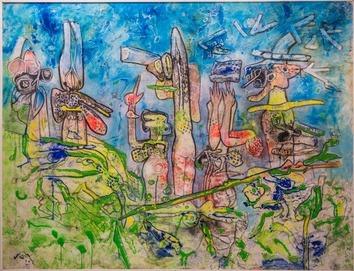
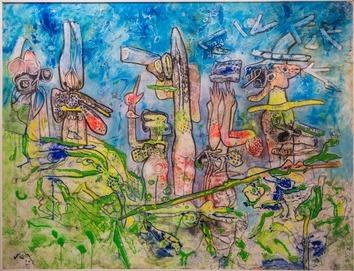
Roberto Matta (1911–2002) was a Chilean painter who joined the Surrealists in Paris and, in wartime New York, helped open the way to Abstract Expressionism. His vast canvases, which he called inscapes, map the forces of the mind and of the cosmos.
Biography
Roberto Sebastián Matta Echaurren was born in Santiago, Chile, in 1911. He studied architecture at the Pontifical Catholic University of Chile, then moved to Paris, where he worked for about two years in Le Corbusier’s studio. In 1936, in Madrid, Pablo Neruda and Federico García Lorca introduced him to Salvador Dalí and André Breton; Breton bought his drawings and in 1937 invited him to join the Surrealist group.
Inscapes
In 1938 Matta painted his first oils, which he called “inscapes” or psychological morphologies: imaginary landscapes conceived as projections of inner states, where lines of force, flares of colour and shifting planes take the place of horizon and ground. One of them, Crucifixión (1938), is today in the collection of the Pérez Art Museum Miami.
New York, 1939–1948
Exiled by the war, Matta lived in New York from 1939 to 1948. He had his first solo show at the Julien Levy Gallery in 1940, and in 1942 the Museum of Modern Art acquired Listen to Living. His automatic, improvised way of painting left a deep mark on the young artists who would become the Abstract Expressionists. After Arshile Gorky’s suicide in 1948 he broke with Breton’s group and returned to Europe, settling in Paris in 1954 and later dividing his time between Paris and Tarquinia, in Italy.
Painting at the scale of architecture
The architect never left the painter. Les puissances du désordre (1964–1965), almost ten metres long, belongs to the Centre Pompidou, and the five canvases of the “open cube” L’Honni aveuglant (1966) enclose the viewer at the Museo Nacional Thyssen-Bornemisza. He painted a mural for UNESCO in Paris in 1956 and, as a supporter of Salvador Allende, a mural for the people of Chile that was painted over after the 1973 coup and restored in 2008. Large formats remained central to his work in his last decades.
Recognition
The Museum of Modern Art organised his first major retrospective in 1957; the Centre Pompidou followed in 1985 and the Museo Nacional Centro de Arte Reina Sofía in 1999. In 2002, months before his death, the Miami Art Museum presented Matta in America: Paintings and Drawings of the 1940s. He received Chile’s National Prize for Plastic Arts in 1990, the Prince of Asturias Award for the Arts in 1992 and the Praemium Imperiale in 1995. His work is held by MoMA, Tate, the Centre Pompidou, the Art Institute of Chicago and the Lowe Art Museum in Coral Gables.
Exhibitions & art fairs
Museums
- Roberto Matta 1911–2002Fondazione Musei Civici di Venezia, Venice, Italy · 2024–2025
- Matta & the Fourth DimensionState Hermitage Museum, Saint Petersburg, Russia · 2019
- The Gift of ArtPérez Art Museum Miami, Miami, Florida, United States · 2019
- Roberto Matta: The Freedom of GestureBoca Raton Museum of Art, Boca Raton, Florida, United States · 2014
- Matta 1911–2011Institut Valencià d’Art Modern (IVAM), Valencia, Spain · 2011
- Matta: The Open CubeMuseo Nacional Thyssen-Bornemisza, Madrid, Spain · 2011
- Matta in America: Paintings and Drawings of the 1940sMiami Art Museum, Miami, Florida, United States · Mar 2002 – Jun 2002
- MattaMuseo Nacional Centro de Arte Reina Sofía, Madrid, Spain · 1999
- MattaMusée national d’art moderne, Centre Pompidou, Paris, France · Oct 1985 – Dec 1985
- Matta: CoïgitumHayward Gallery, London, United Kingdom · 1977
- MattaThe Museum of Modern Art, New York, United States · 1957