
Secondary Market
FAILE
American, Founded 1999
Brooklyn-based collaborative duo assembling fragments of advertising, comics, devotional imagery and street graphics into layered works about desire and belief.
Biography
FAILE was founded in 1999 by Patrick McNeil and Patrick Miller, artists who met as teenagers and later established their collaborative practice in Brooklyn. The name emerged from an anagram of “A Life,” reflecting an early interest in identity, chance and the instability of images. Their first projects developed through wheat-pasted posters, stencils and street interventions, where repetition and physical weathering became part of the work.
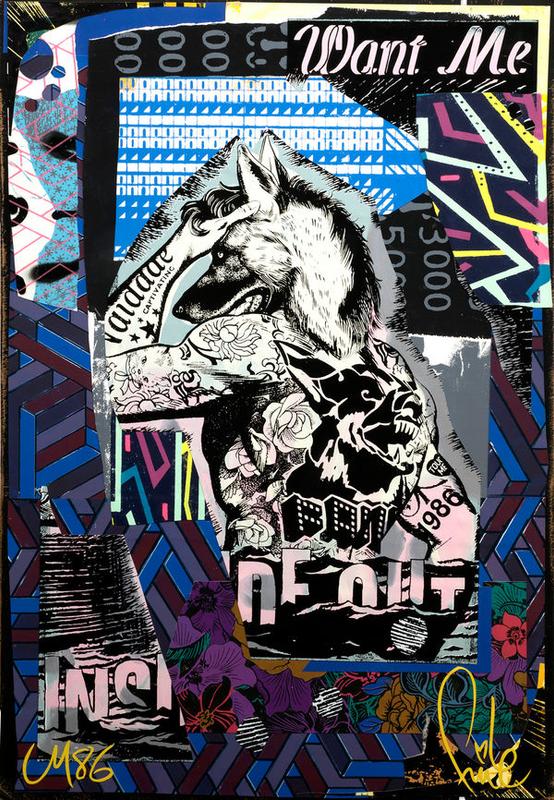
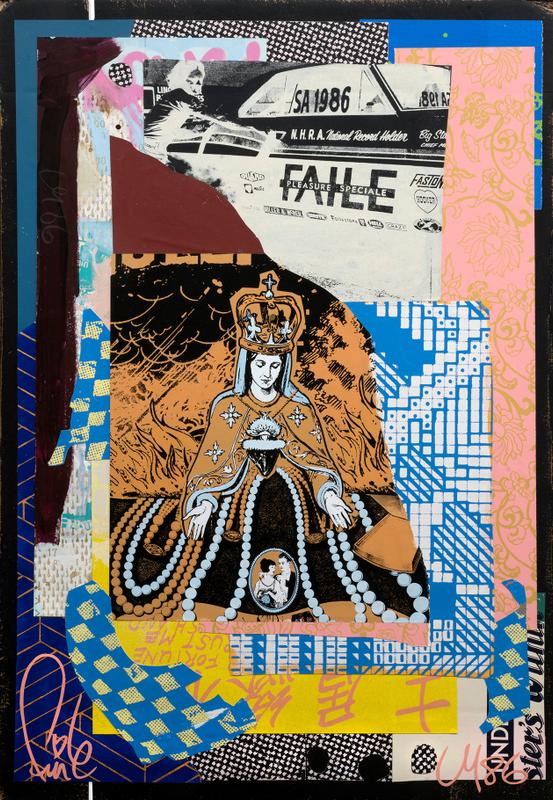
The duo’s visual archive draws from advertising, comics, pulp fiction, devotional art, tattoos, video games and regional signage. Rather than preserving those sources intact, FAILE cuts, layers and recombines them into compositions that resemble walls built up over time. A heroic figure may appear beside a consumer slogan or religious emblem, creating tension between private belief, public persuasion and commercial desire.
Printmaking remains fundamental to the practice. Screenprint allows images to repeat, shift color and accumulate imperfections, while woodblock and relief processes give the surface a more physical structure. In paintings, carved panels and editions, FAILE uses repetition not merely as a Pop strategy but as a way to show how images gain and lose meaning through circulation.
Sculpture and installation have expanded this language. Temple-like structures, carved prayer wheels and large public works bring together sacred architecture and contemporary visual culture. The ongoing Deluxx Fluxx project, developed with artist Bast, transforms arcade games, fluorescent graphics and sound into an interactive environment in which viewers participate rather than remain outside the work.
FAILE’s collaboration depends on exchange rather than individual signature. Images pass between the two artists, are revised, overprinted and returned to the shared archive. This process mirrors the broader subject of their work: cultural material is never fixed, but continually copied, damaged, desired and rebuilt. Their practice turns that circulation into a form of collective memory.
Exhibitions & art fairs
Galleries
- Exclusive End of Summer OffersMFA · Aug 2025 – Sep 2025