
May 24, 2016 – September 4, 2016
Banksy: War, Capitalism & Liberty
An Unauthorized Museum Exhibition from Private Collections
Palazzo Cipolla, Rome, Italy
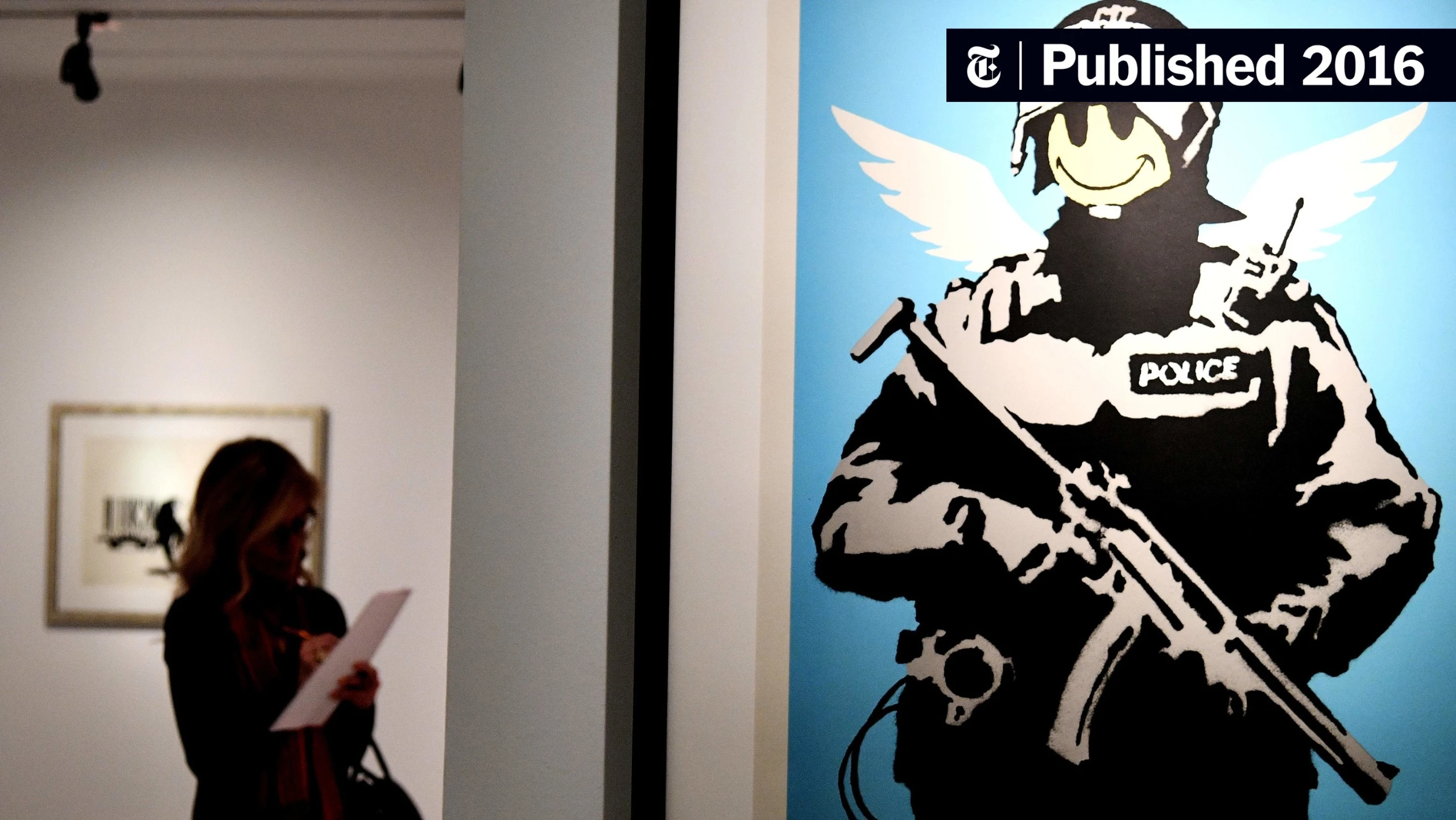
Banksy: War, Capitalism & Liberty assembled more than 120 original works from international private collections at Palazzo Cipolla in Rome. Paintings, sculptures, prints and rare objects were organized around three recurring areas of Banksy’s practice: organized violence, economic power and the contested idea of individual freedom.
Banksy did not authorize, organize or participate in the exhibition. It must therefore be understood as an independent institutional interpretation of his work rather than an artist-led retrospective. That distinction is central to the significance and the limitations of the project.
A Political Vocabulary Across Media
The exhibition demonstrated how Banksy’s recurring figures change meaning across different formats. Soldiers, children, police officers, rats, monkeys and familiar cultural icons appeared in paintings, editions, sculptural objects and graphic material.
Grouping the works thematically allowed connections to emerge across periods. Images addressing military power could be considered beside works about surveillance or displaced populations, while critiques of consumer culture appeared alongside objects whose own circulation through the art market introduced an additional contradiction.
The three-part structure did not suggest that war, capitalism and liberty operate independently. Throughout Banksy’s work, political violence is connected with economic systems, while personal freedom is frequently limited by authority, borders or public conformity.
Presented away from their original street settings, the works became evidence from which the curators constructed a broader political reading.
The Paradox of an Unauthorized Retrospective
The Palazzo Cipolla setting created a deliberate tension. Art associated with walls, temporary interventions and resistance to cultural authority was displayed within an ornate institutional interior using works borrowed from private owners.
The exhibition offered access to paintings and objects that would otherwise have remained dispersed across private collections. At the same time, it lacked Banksy’s control over selection, sequence and interpretation.
Authenticity and authorization are not the same thing. An individual work may be genuine without the artist endorsing the exhibition in which it appears. For Banksy, whose practice repeatedly questions ownership and institutional legitimacy, that distinction becomes particularly important.
Produced by the Fondazione Terzo Pilastro and jointly curated through Andipa and 999Contemporary, the project remains significant as an early large-scale museum attempt to organize Banksy’s studio work into a political narrative. Its independent status should remain visible whenever the exhibition is discussed.
Related artists