
April 17, 2011 – August 8, 2011
Art in the Streets
Banksy in MOCA’s Landmark Survey of Graffiti and Street Art
The Geffen Contemporary at MOCA, Los Angeles, California
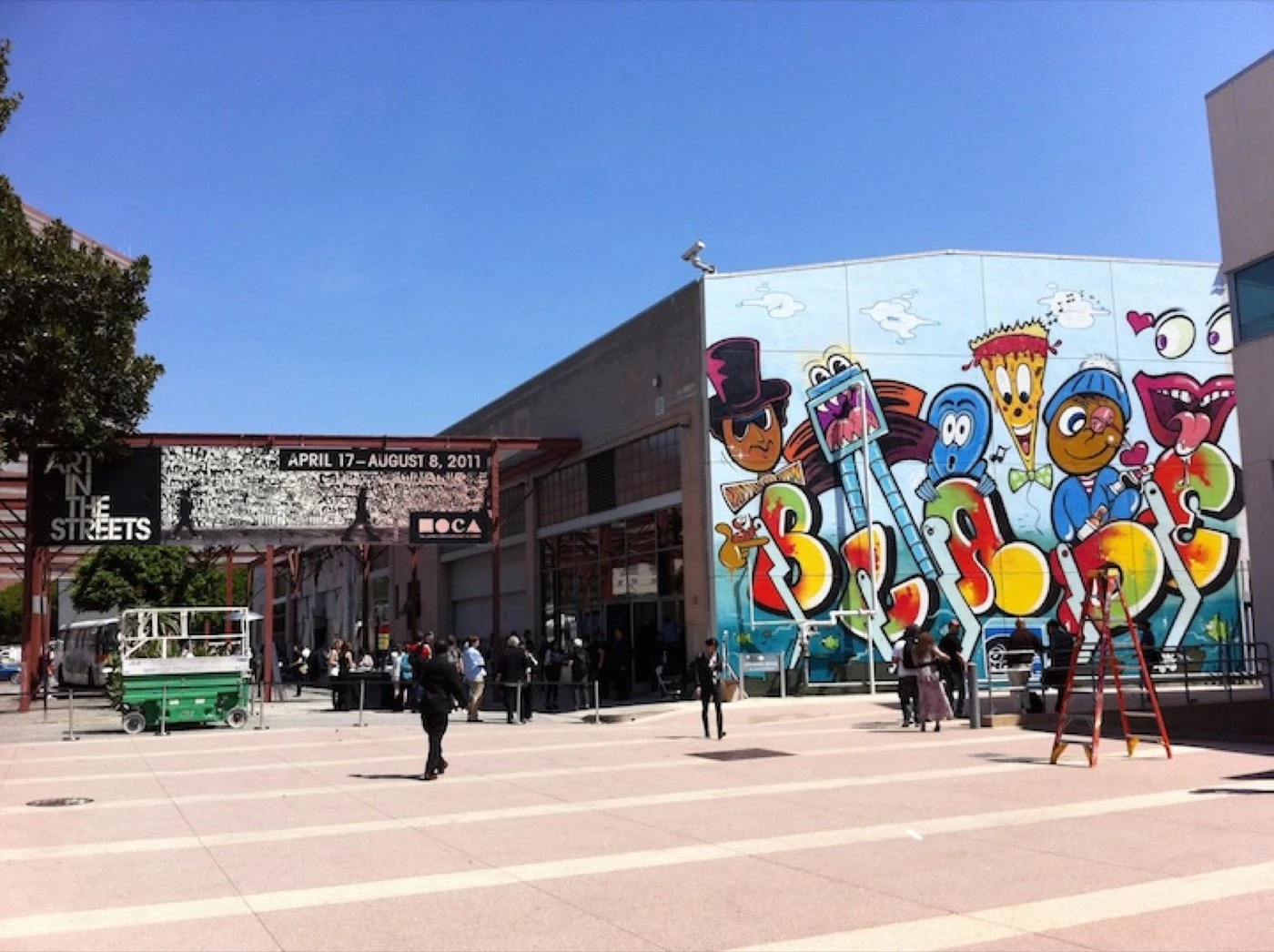
Art in the Streets was the first major United States museum survey devoted to the history of graffiti and street art. Presented at The Geffen Contemporary at MOCA in Los Angeles, the exhibition brought together fifty artists and traced the development of these practices from the 1970s to an international movement.
Banksy participated within this broader history through a dedicated installation combining stencils, reconstructed images, sketches and animated elements. His presence placed the mythology surrounding one anonymous artist alongside the communities, cities and visual traditions from which contemporary street art had developed.
From Individual Artist to Movement History
The exhibition shifted attention away from the idea that graffiti and street art could be explained through a small number of celebrated personalities. Its historical structure moved between New York, Los Angeles, San Francisco, London and São Paulo, connecting individual practices with local languages, music, photography, skate culture and forms of urban identity.
Banksy’s work entered this chronology as part of the London chapter and as an example of how stencil-based intervention had reached an international audience. Familiar images were shown alongside works derived from outdoor projects, sketches and animatronic constructions.
Inside a museum, those objects no longer carried the immediate risks associated with their original production. Their inclusion instead invited comparison with other artists who had developed different relationships to lettering, murals, public property and unsanctioned image-making.
The result situated Banksy within a history that preceded his public recognition and continued beyond the boundaries of his own practice.
Access as Part of the Participation
Banksy’s contribution extended beyond the works in his installation. During the final weeks of the exhibition, he sponsored free admission to MOCA every Monday, allowing visitors to enter without paying the museum’s normal ticket price.
The gesture addressed a contradiction at the center of Art in the Streets. An exhibition devoted to art encountered freely in public space had been transferred into an institution with controlled entry and paid admission.
By financing access rather than adding another object, Banksy turned the economics of museum attendance into part of his participation. The action did not remove the exhibition from the institution, but it made the threshold more visible.
Organized by Jeffrey Deitch with Roger Gastman and Aaron Rose, Art in the Streets marked an important stage in the museum recognition of graffiti and street art in the United States. Banksy’s inclusion mattered not because it isolated him from the movement, but because it placed his work inside a more complex cultural and historical field.
Related artists