
June 1, 2017 – December 31, 2017
Orlinski / Pompon: Le Choc des Titans
Two Generations of Animal Sculpture at Musée François Pompon
Musée François Pompon, Saulieu, France
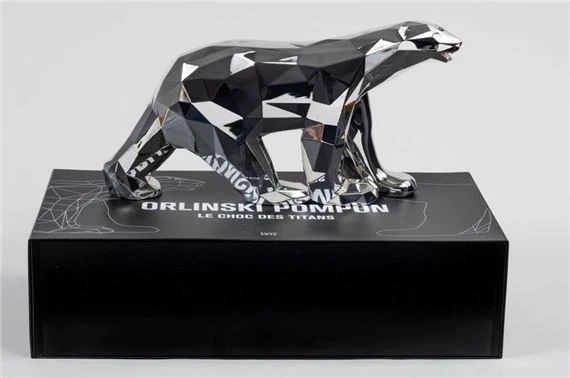
Orlinski / Pompon: Le Choc des Titans placed Richard Orlinski’s contemporary animal sculpture in direct dialogue with the work of François Pompon at the museum dedicated to the celebrated Burgundian sculptor. Presented in Saulieu from June through December 2017, the exhibition brought Orlinski’s faceted animals into a collection shaped by one of the defining figures of twentieth-century animal sculpture.
The encounter revealed less a question of influence than two contrasting approaches to reduction. Pompon simplified the animal into continuous volumes and restrained surfaces; Orlinski reconstructs recognizable bodies through angular planes, saturated color and materials that actively catch the light.
Two Ways of Simplifying the Animal
François Pompon spent decades reducing anatomical detail in search of an essential line. Fur, feathers and surface description gave way to smooth masses in which movement could be understood through silhouette and volume. His animals retain their identity without depending on literal naturalism.
Orlinski arrives at simplification through an almost opposite visual process. Instead of smoothing transitions, he breaks the body into facets. Muscles and contours become sequences of planes whose appearance shifts according to light, material and viewpoint. Resin, aluminum, transparency and intense color introduce a visual vocabulary rooted in contemporary production and popular imagery.
Placed within the same museum, these approaches created a productive tension. Both artists move away from exact anatomical reproduction, but one seeks continuity while the other foregrounds fragmentation. The comparison allowed animal sculpture to be read not as a fixed tradition, but as a language capable of changing radically across generations.
The museum presentation included a broad selection of Orlinski’s bestiary, from bears, panthers, crocodiles and a tiger to an eagle, elephant, horse, wolf, lion, bull and different interpretations of Wild Kong. Seen alongside the museum’s Pompon collection, their diversity made the contrast between surface, scale and material particularly visible.
From the Museum Into Saulieu
The project extended beyond the galleries. Beginning in April 2017, monumental sculptures by Orlinski appeared throughout Saulieu, turning the town associated with Pompon’s life and legacy into an open-air continuation of the museum encounter.
The outdoor route included a five-meter Standing Wild Bear, a four-meter Kong with barrel, a monumental lion, panther, rearing horse and crocodile, as well as two red bulls positioned face to face. The works occupied squares, streets, the museum courtyard and other public sites, allowing the comparison between historical and contemporary animal sculpture to unfold across the town itself.
One of the clearest encounters placed Orlinski’s large faceted bear in proximity to the smooth white bear associated with Pompon’s visual legacy. The contrast made the exhibition’s central idea immediately legible: similar subjects can produce radically different sculptural experiences when volume, surface and light are treated according to different periods and artistic intentions.
The project generated enough interest to lead to the later publication of Orlinski-Pompon: Le Choc des Titans by Albin Michel. By moving between museum galleries and public space, the 2017 presentation became an important institutional moment in Orlinski’s career and situated his Born Wild vocabulary within a longer history of French animal sculpture.
Related artists