La Danse du Lion, 2026
A Gothic masterpiece, rebuilt
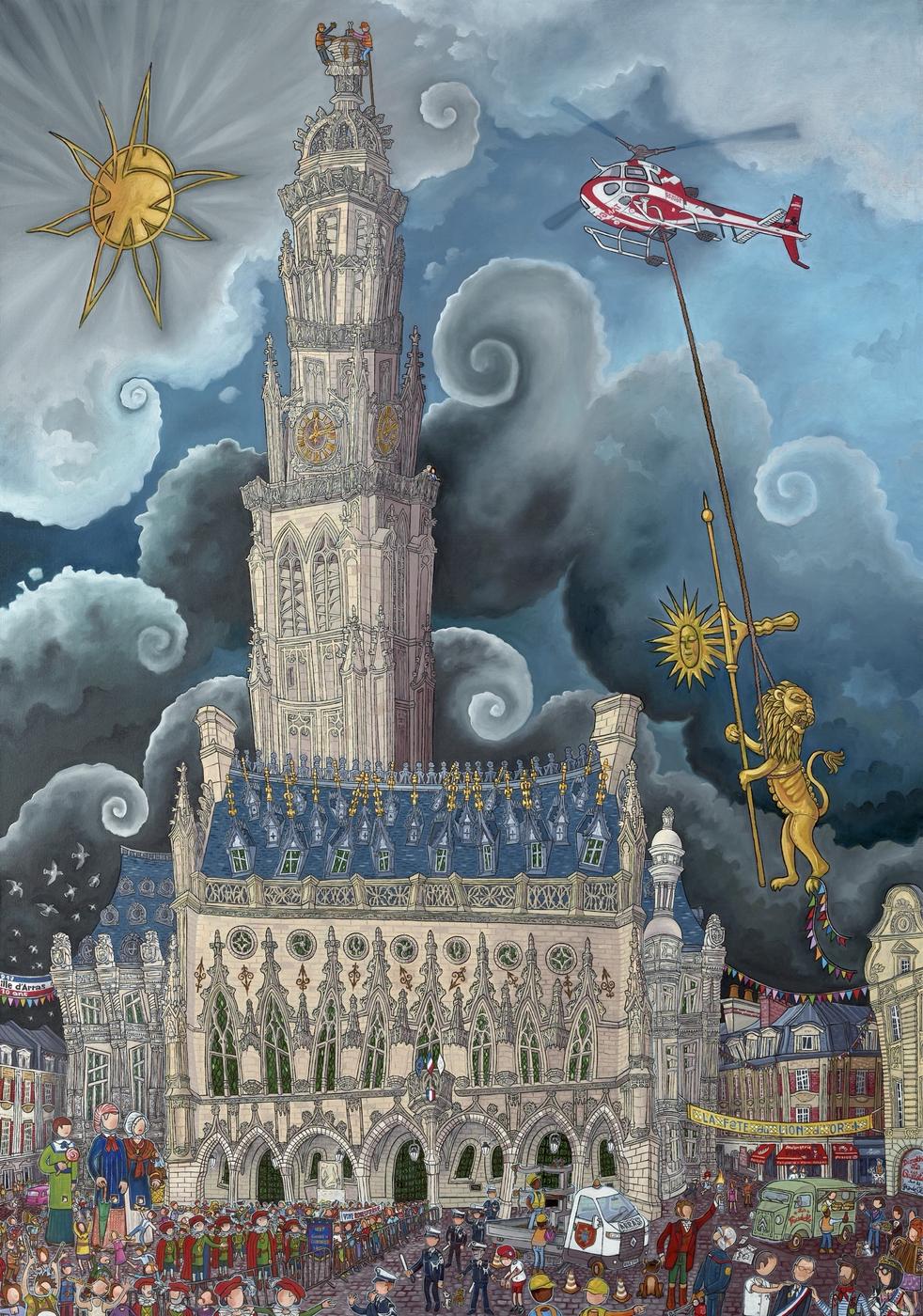
Built in the sixteenth century in the Flamboyant Gothic style, the town hall of Arras is crowned by a 75-metre belfry, a symbol of the town’s civic freedoms. Destroyed by shellfire in 1914, the building and its tower were rebuilt identically between the wars under the architect Pierre Paquet, and since 2005 the belfry has been on the UNESCO World Heritage List with the belfries of Belgium and France. Godon renders every pinnacle, every dormer of the blue roof and every piece of tracery, yet he stretches the tower towards the sky and draws the gabled houses of the square in around it, like a crowd around a hero.
Chasing away evil spirits
In China, the lion dance accompanies New Year celebrations to drive away evil spirits. Godon transposes the rite: the evil spirits are the dark clouds coiling in spirals above the square, and the lucky charm is the lion of Arras, emblem of the town, dancing at the end of its rope. Down below, the people of Arras dance with it.
Three chapters of the history of Arras
The lion holds up a sun: that of the Sun King, Louis XIV, under whose reign Arras became French for good. Yet Arras is also the town where Maximilien de Robespierre was born, in 1758. Godon plays on the paradox: Phrygian caps run to protest against the royal emblem, and Robespierre burns a newspaper bearing the effigy of the Lion King. In the bakery facing the belfry, Eugène-François Vidocq, the rogue who became head of the Sûreté, was born in 1775. A banner recalls the 110th anniversary of the Battle of Arras (1917): Arras is also a town of resistance.
A ch’ti celebration
Above all, the canvas is a popular festival of the North of France. The town’s giants lead the procession with the brass band, followed, more discreetly, by l’Ami Bidasse, an emblematic figure of Arras. In a corner, the accordionist Yvette Horner, though not from Arras, adds to the popular spirit of the scene, while the brotherhood of the andouillette, the fries stand and the fricadelles complete the regional festivities. Workers and bosses replay the story of the revolutionaries and the king over a cone of fries.
A personal history
Godon slips his own childhood into the scene. The École Saint-Joseph he attended stood opposite the Palais Saint-Vaast, where the young Alain discovered Pieter Bruegel the Elder, who would become a lasting source of inspiration. The belfry is his madeleine: his uncle, who taught him to paint, often sketched it. Facing the belfry, a harlequin Great Dane lived in a fishmonger’s shop and fascinated the little boy; as an adult, he would own three. And the father of one of his closest friends owned the Pressing Marco, the dry cleaner where his father, his uncle and his grandfather took their suits; in the painting, its name is spelt “Marko”.
After Bruegel
The crowded square pays tribute to Bruegel, discovered as a child at the Palais Saint-Vaast. Pieter Bruegel the Elder made the village festival a subject for painting, notably in The Fight Between Carnival and Lent (1559), where a whole community fills the town square. Godon spent nearly five months on the canvas, and, as in front of a Bruegel, every corner of it hides a scene.
Read Bernard Markowicz on La Danse du Lion and his father’s dry cleaner.
Adapted from the descriptive text accompanying the painting (2026).