Secondary Market
Keith Haring
American, 1958–1990
Keith Haring (1958–1990) was an American artist whose bold, rhythmic line — radiant babies, barking dogs, dancing figures — travelled from New York subway walls to museums worldwide. A public artist and an activist, he used his imagery to speak about AIDS, drugs and social justice.
Biography
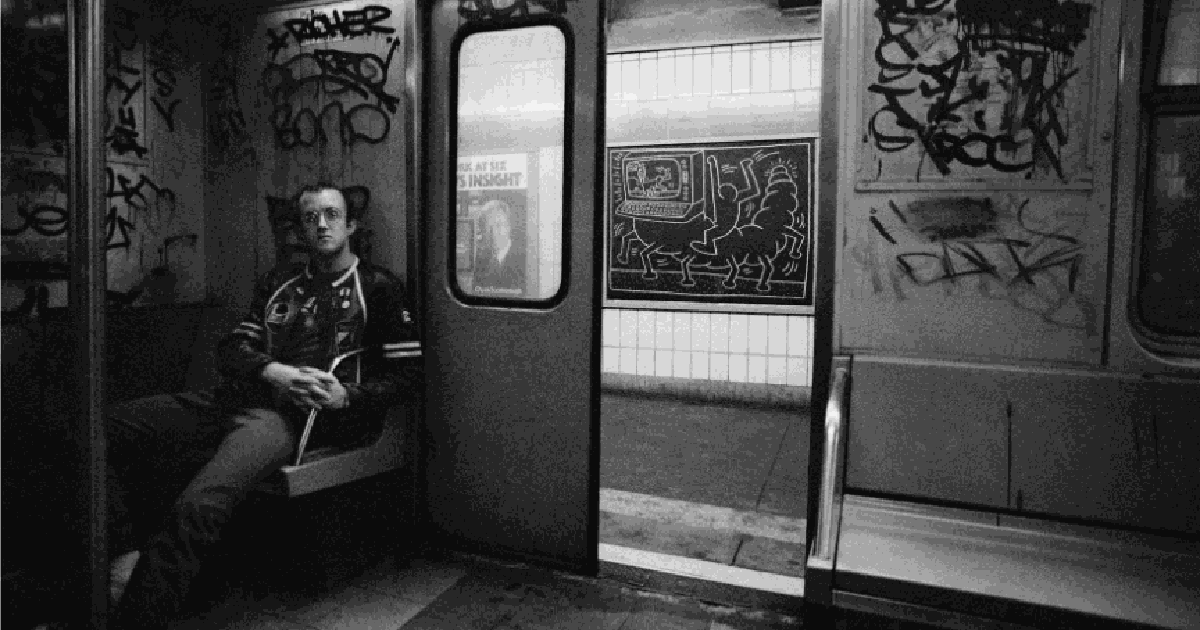
Keith Haring was born in Reading, Pennsylvania, in 1958 and grew up in nearby Kutztown. After a short spell at the Ivy School of Professional Art in Pittsburgh, where he had his first solo show in 1978, he moved to New York that year to study at the School of Visual Arts. He became part of the scene around Club 57 in the East Village and, from 1980 to 1985, made hundreds of drawings on the empty advertising panels of the subway.
A line for everyone
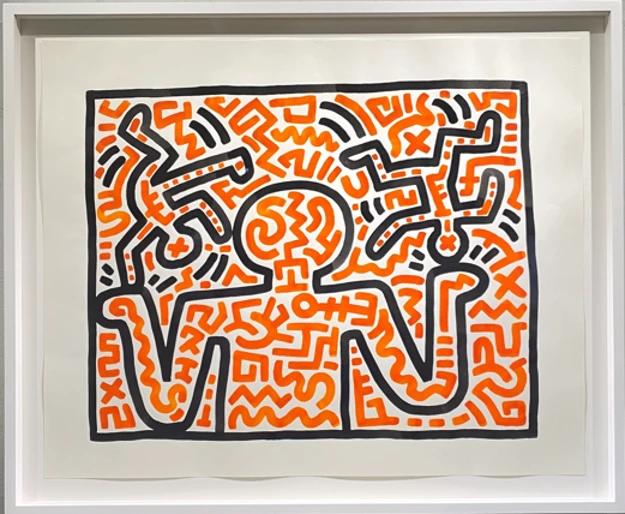
Haring’s vocabulary — the radiant baby, the barking dog, the flying devil, figures in motion — was meant to be read at a glance by anyone. He wanted art to leave the gallery: in 1986 he opened the Pop Shop in SoHo, selling affordable objects that carried his images, followed in 1988 by a shop in Tokyo. That year a satellite store, Wham Bam, operated on Washington Avenue in South Beach, where Haring attended a reception in May 1988. Don and Mera Rubell, whose collection is now the Rubell Museum in Miami, had bought his work directly from him in 1981–1982.
Public walls and activism
Murals carried his message into the street: Crack Is Wack in East Harlem and a section of the Berlin Wall near Checkpoint Charlie (1986), Tower at the Necker-Enfants Malades hospital in Paris (1987), Todos Juntos Podemos Parar el SIDA in Barcelona and Tuttomondo in Pisa (1989). Diagnosed with AIDS in 1988, he set up the Keith Haring Foundation in 1989 to support AIDS organisations and programmes for children. He died in New York in February 1990, aged 31, weeks after completing the bronze altarpiece The Life of Christ.
Prints: Apocalypse and Icons
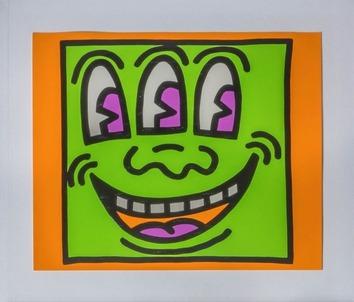
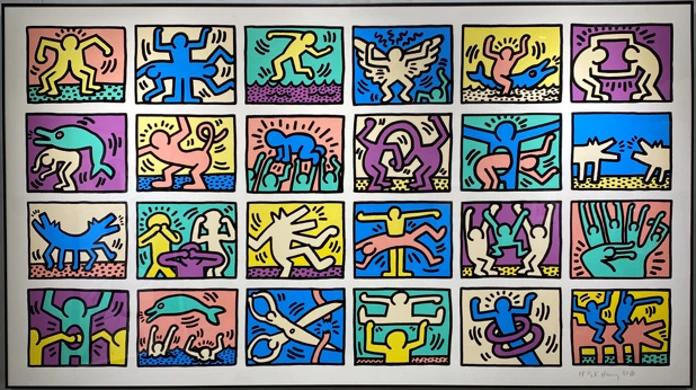
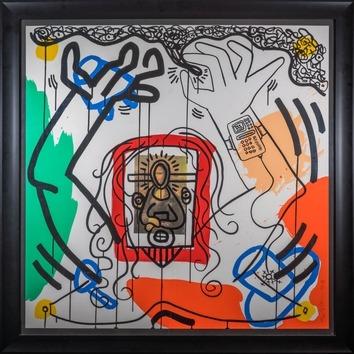
Printmaking served his wish to reach a wide public. In 1988 he paired ten screenprints with ten texts by William S. Burroughs — whom he had first heard at the 1978 Nova Convention — in the portfolio Apocalypse, where Christian imagery, sexuality and the fears of the AIDS years collide. Icons (1990), five screenprints with embossing — Radiant Baby, Barking Dog, Flying Devil, Angel and Three Eyed Monster — distils his signs into emblems.
Museums
Haring took part in documenta 7 in 1982 and in the São Paulo Biennial and the Whitney Biennial in 1983. Major retrospectives followed at the Whitney Museum of American Art (1997), the Brooklyn Museum (2012), the Musée d’Art Moderne de Paris (2013), the Albertina in Vienna (2018), Tate Liverpool (2019) and The Broad in Los Angeles (2023). His work is held by the Museum of Modern Art and the Whitney in New York, the Denver Art Museum and the Rubell Museum in Miami.
Exhibitions & art fairs
Museums
- Keith Haring: Art Is for EverybodyThe Broad, Los Angeles, California, United States · May 2023 – Oct 2023
- Apocalypse Sky: Art, AIDS, and Activism in New York City, 1982–1992Frances Lehman Loeb Art Center, Vassar College, Poughkeepsie, New York, United States · Feb 2023 – Sep 2023
- Keith HaringTate Liverpool, Liverpool, United Kingdom · Jun 2019 – Nov 2019
- Keith Haring | Jean-Michel Basquiat: Crossing LinesNational Gallery of Victoria, Melbourne, Australia · 2019–2020
- Keith Haring. The AlphabetAlbertina, Vienna, Austria · Mar 2018 – Jun 2018
- Keith Haring: The Political Linede Young Museum, San Francisco, California, United States · 2014–2015
- Keith Haring: The Political LineMusée d’Art Moderne de la Ville de Paris and CENTQUATRE, Paris, France · 2013
- Keith Haring: 1978–1982Brooklyn Museum, New York, United States · 2012
- Keith HaringWhitney Museum of American Art, New York, United States · 1997
- Keith HaringMuseum of Contemporary Art Australia, Sydney, Australia · 1996
- 1983 Whitney BiennialWhitney Museum of American Art, New York, United States · 1983
- Bienal de São PauloBienal de São Paulo, São Paulo, Brazil · 1983