
Exhibited Artist
Dorit Levinstein
1956
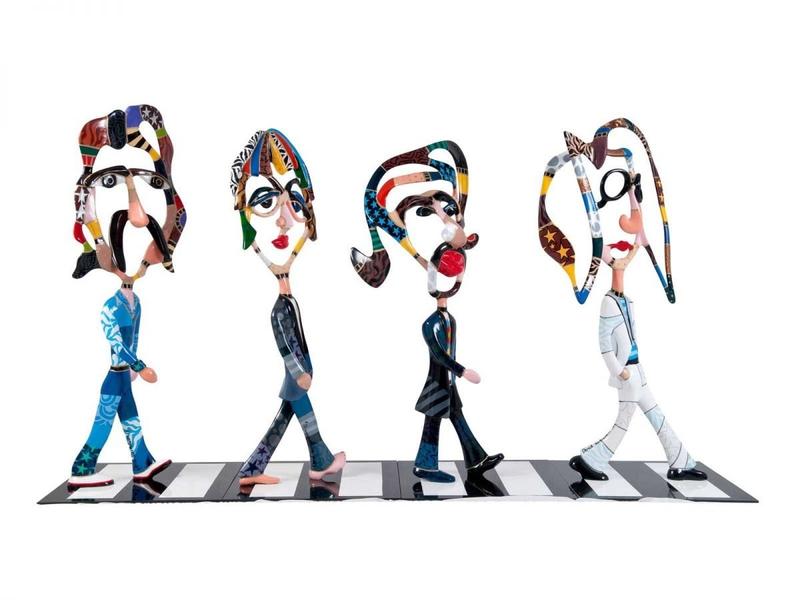
Dorit Levinstein (Israeli, b. 1956) treats sculpture as a form of drawing released into space. Her figures are organized around a continuous, elastic line that bends, rises and balances with the lightness of choreography. Human bodies, animals, flowers, words and familiar cultural figures become slender volumes whose open silhouettes allow the surrounding architecture and landscape to remain part of the work. The apparent spontaneity is carefully controlled, since every turn of the line must carry movement, identity and structural equilibrium at once.
Born in Haifa, Levinstein graduated from the Technion in 1978 with a degree in graphic design and a concentration in illustration. She continued her studies in painting and sculpture at the Avni Institute of Art in Tel Aviv and completed further training at the Art Academy of Ramat Hasharon. From 1985 to 1988, she taught at the Avni Institute, and in 1988 she received a prize for excellence from Soho Gallery in New York. Although she moved decisively toward sculpture in her early thirties, she has consistently described herself as a painter as well as a sculptor.
That dual identity is visible in the construction of the work. Bronze and aluminum provide physical structure, while hand-painted color animates the surface through stripes, spirals, dots and rhythmic fields. The pattern does not simply decorate a finished object. It follows the sculpture around curves and through changing planes, making the work unfold over time as the viewer moves. Levinstein’s practice has developed through classical bronze, stone and mixed media, and the colorful linear figures for which she is now best known.
Her subjects move freely between observation and cultural memory. Dancers, musicians, flowers and animals share the same visual language as figures inspired by art history, popular music and contemporary iconography. In works such as The Beatles, the familiar Abbey Road procession is translated into four buoyant, independent forms. Recognition remains immediate, but the image is rebuilt through Levinstein’s own grammar of line, balance and color rather than reproduced as illustration.
Levinstein has created commissioned works for interior and outdoor settings, and her monumental sculptures have entered public landscapes in several countries. In 2026, nine large-scale works were installed along Park Avenue between 34th and 39th Streets in New York for a year-long open-air presentation. Their placement in the city demonstrates an essential quality of her practice: the sculptures remain visually light even at an architectural scale, using movement and negative space to engage rather than dominate their surroundings.
Markowicz Fine Art presents Dorit Levinstein’s work within the gallery’s program of contemporary sculpture, including an artist’s proof of The Beatles in hand-painted aluminum. Across intimate and monumental formats, her achievement lies in making solid material feel airborne. Line becomes body, color becomes rhythm, and sculpture becomes an encounter that changes with every step around it.