
Secondary Market
Donald Sultan
American, born 1951
American artist combining industrial materials with simplified botanical and still-life forms to create images that feel both weighty and graphically immediate.
Biography
Donald Sultan was born in Asheville, North Carolina, in 1951. He studied at the University of North Carolina at Chapel Hill and earned an MFA from the School of the Art Institute of Chicago. After moving to New York in 1975, he became associated with the return to recognizable imagery often described as New Image Painting, though his material choices set his work apart from conventional painting.
Sultan constructs many works on panels faced with vinyl floor tile. Tar, plaster, spackle and other building materials are applied, scraped and cut into the surface. These substances give the image unusual weight and depth, while the grid of the underlying tile remains visible as a quiet structural system.
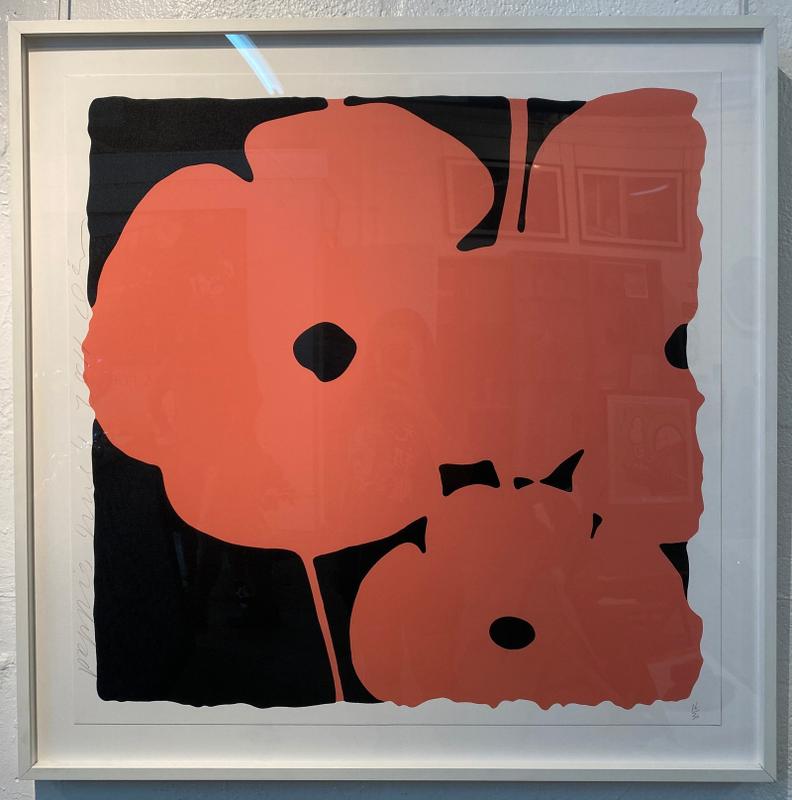
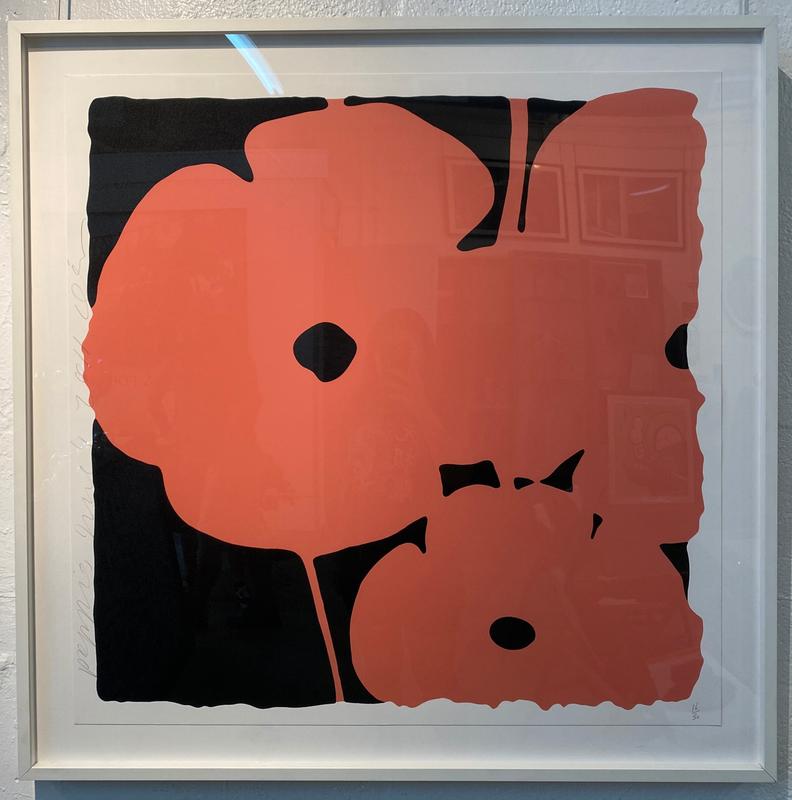
Flowers, lemons, poppies, buttons, dominoes and other objects recur throughout his work. Their silhouettes are simplified and often enlarged until representation approaches abstraction. A black form may read first as a dense field, then resolve into fruit or petals. Sultan’s cropping and repetition make the subject feel graphic, while irregular surfaces preserve evidence of physical labor.
The contrast between image and material is essential. Flowers suggest growth, beauty and fragility, yet they are built from substances associated with roofs, roads and construction. This opposition prevents the still life from becoming merely decorative. The work can carry references to mortality, industrial transformation and the vulnerability of natural forms within built environments.
Sultan has also made drawings, prints and sculpture in which the same motifs shift across scale and medium. Charcoal drawings can appear softer and more atmospheric, while screenprints emphasize flatness, pattern and color. Sculpture gives the familiar silhouettes literal volume.
Across more than four decades, Sultan has sustained a disciplined vocabulary without treating repetition as limitation. Each return to a flower, fruit or object becomes a test of material, edge and proportion. His work demonstrates how a still life can remain rooted in ordinary things while operating with the authority of abstract form.