
Exhibited Artist
Esther Glina Montagner
1950
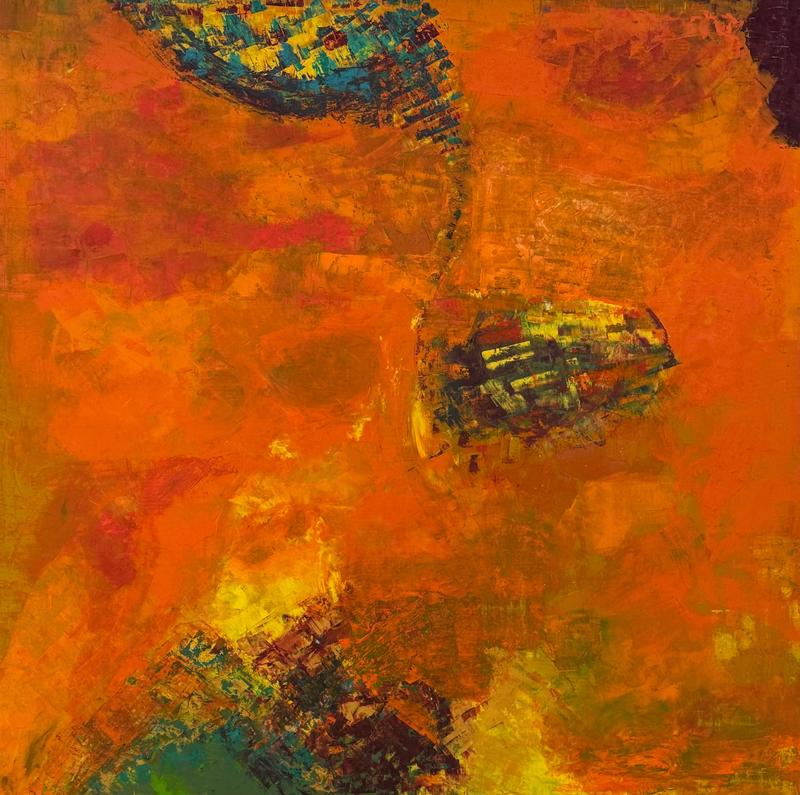
Esther Glina Montagner (American, b. 1950) approaches abstraction as a form of witness. Saturated color, thick strokes, collage, fragments of language and found objects accumulate into works that feel immediate, physical and emotionally charged. Her paintings do not separate formal experimentation from lived experience. Color carries atmosphere, texture records pressure and revision, and scale gives private memory a public presence.
Born in New York to Eastern European Jewish survivors of the Second World War, Montagner grew up within a family history shaped by migration, loss and cultural continuity. She was named for two grandmothers and an aunt who were killed, and she signs her work “Glina,” her maiden name, as an act of remembrance. The signature is therefore more than an artistic brand. It keeps a family name visible and connects even her most nonfigurative works to questions of identity, inheritance and survival.
Montagner’s practice has never been confined to a single style or material. She works in oil, acrylic, enamel, collage, assemblage and installation, allowing the subject to determine the form. Deep hues and broad, tactile passages can be interrupted by geometric structures, printed matter or ordinary objects. Rather than pursuing consistency for its own sake, she treats each body of work as a visual time capsule, capable of holding personal events, social tension and the changing texture of contemporary life.
The permanent installation Those People, installed by the Virginia Holocaust Museum in 2009, gives this commitment its clearest historical dimension. The work brings together 36 original oil paintings with painted and actual suitcases bearing the names of members of her family. By restoring names to people who had been reduced to absence, Montagner transformed family research into an environment of color, objects and testimony. The installation demonstrates how abstraction can carry historical memory without illustrating it literally.
A second permanent museum work, Flight, Training Wheels and Wings, was installed at the San Diego Air & Space Museum in 2008. Extending approximately 22 feet, the oil painting translates the history and imagination of flight into an expansive abstract sequence. Its movement across the wall reflects a recurring quality in Montagner’s work: the desire to turn an idea into a spatial experience rather than a single, self-contained image.
Travel and long periods spent between the United States and Europe broadened Montagner’s visual vocabulary, but the work remains anchored in the tension between inherited tradition and continual reinvention. Her recent paintings preserve the intensity of her earlier installations while allowing color and surface to operate with greater independence. Across canvas, collage and constructed objects, she uses abstraction not to withdraw from the world, but to register how memory, culture and emotion change over time.