
Secondary Market
Arman
French, 1928–2005
French-American artist who used accumulation, cutting and destruction to reveal the social life of ordinary objects in a culture of abundance.
Biography
Arman was born Armand Pierre Fernandez in Nice in 1928. He studied at the École Nationale des Arts Décoratifs in Nice and the École du Louvre in Paris, where archaeology and Asian art informed his understanding of objects. During the 1950s, he shortened his public name to Arman and moved away from conventional painting toward processes based on repetition and material evidence.
The Cachets works used rubber stamps to build abstract fields from repeated marks. Soon afterward, Arman began treating actual objects as his medium. Poubelles enclosed refuse within transparent containers, while Accumulations brought together large numbers of similar items such as watches, tools, shoes or musical parts. Quantity replaced the uniqueness normally associated with sculpture.
In 1960 Arman joined Yves Klein, Jean Tinguely, Daniel Spoerri, Niki de Saint Phalle and others in Nouveau Réalisme, the movement defined by critic Pierre Restany around new ways of approaching reality. That same year, Arman filled Galerie Iris Clert with garbage for Le Plein, responding to Klein’s earlier empty-gallery exhibition Le Vide. The gesture made abundance itself into an environment.
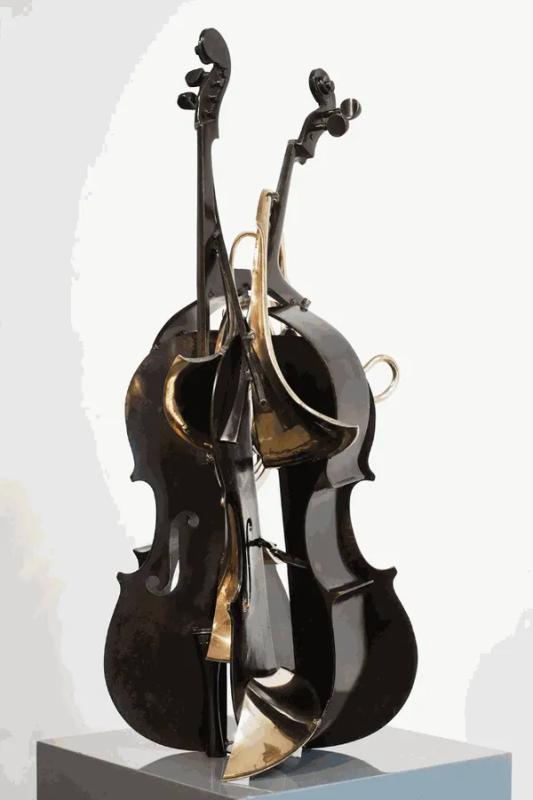
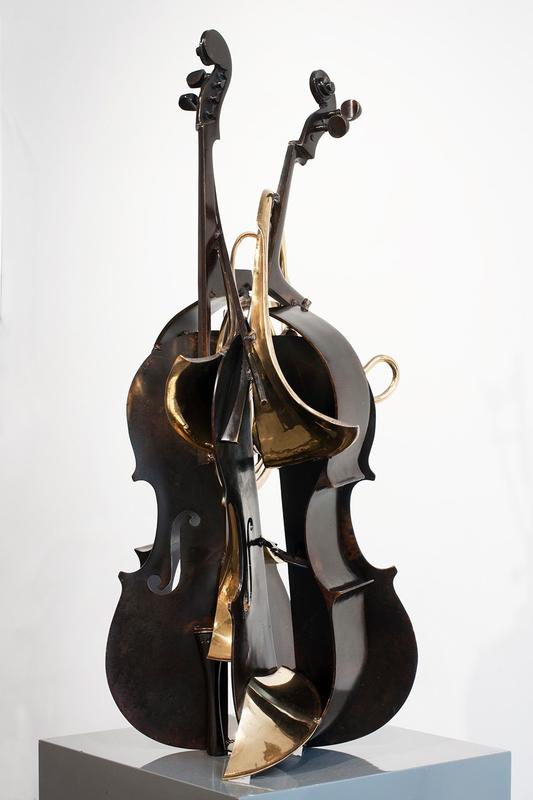
Destruction became another method of analysis. In the Coupes and Colères, objects were sliced, burned or smashed and then reorganized. Violins, cellos, pianos and other instruments appeared repeatedly, carrying both formal elegance and cultural memory. By damaging them, Arman did not simply negate their function; he exposed their internal structures and transformed fragments into rhythm.
After establishing a strong connection with New York in the 1960s, Arman worked between France and the United States and became a naturalized American citizen. His later practice included cast bronze objects and monumental public works such as Long Term Parking and Hope for Peace, in which cars and military vehicles were accumulated at architectural scale.
Arman’s work anticipated major concerns in late twentieth-century art: consumer waste, serial production, recycling and the unstable boundary between possession and disposal. His objects remain recognizable, but their ordinary use has been suspended. What remains is a social portrait built from the things people manufacture, desire, collect and destroy.
Exhibitions & art fairs
Art fairs
- ART PALM BEACH 2026Jan 2026 – Feb 2026
- Art Miami 2023: Markowicz Fine ArtDec 2023